|
Waoline.com Premier visual portal on the web |
The Stirling Motor Clean Motors |
Local page - New energy menu - Economy menu - Food & Restaurants - Waoline menu - Research on Google Open Menu |
|
|
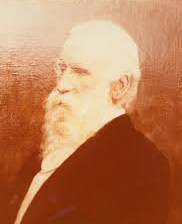
| Story of Stirling motor | The Stirling Heat Engine was the inspiration of the Reverend Robert Stirling from Cloag in Scotland. The Scottish vicars first engine, built in 1816 was a large affair with a cylinder 3.05 metres (10 ft) high and with a bore of 0.6 metres (2 ft). In 1876 Rev. Stirling wrote in a letter about his brother James, who had just died, "......These imperfections have been in great measure removed by time and especially by the genius of the distinguished Bessemer. If Bessemer iron or steel had been known thirty five or forty years ago there is scarce a doubt that the air engine would have been a great success...It remains for some skilled and ambitious mechanist in a future age to repeat it under favourable circumstances and with complete success...." Rev'd Dr. Robert Stirling (1790-1878) from "Stirling Engines" by G. Walker
|  | | | Stirling Cryogenics & Refriger |
|
| Wath is the Sirling motor | " The Stirling Engine was named by Dr. Rolf. J. Meijer who at that time was a project manager with Philips of Holland. Philips was struggling with creating a new name to call the 'Air' engine when there was no air inside the engine. This is because in an Air engine, the air inside the engine is called the 'working gas'. If you change the 'working gas' to a gas like Helium or Hydrogen, then it can no longer be called an 'Air' engine. The name Stirling Engine was chosen in honor of the inventor of the regenerator (economizer) and the engine that demonstrated its use.
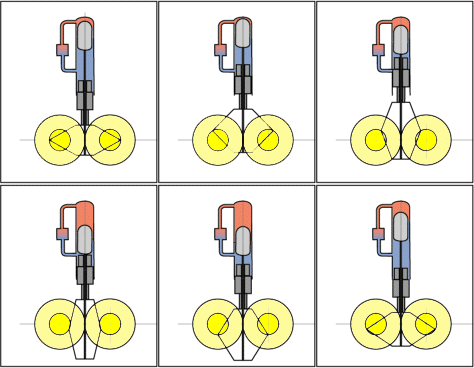
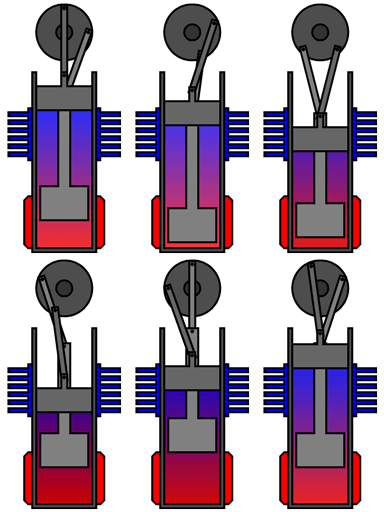
The Stirling Engine's most basic configuration consists of two pistons each in its own cylinder. (Sometimes it is easier to envision these two cylinders as one long tube with the piston heads facing each other inside the tube (see the figure below)). Note that between these two pistons heads are the heater, cooler and regenerator. The regenerator (usually a block of woven wire) is in the center of this tube and the heater is between the regenerator and one piston (in red) while the cooler is between the regenerator and the other piston (in Blue). The volume attached to the 'heater' is the 'expansion space' where the hot gas pushes against the 'expansion piston'. The volume attached to the 'cooler' is the 'compression space'." Stirling Engine Society - USA
| 
|
|
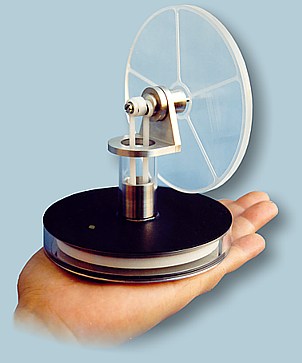
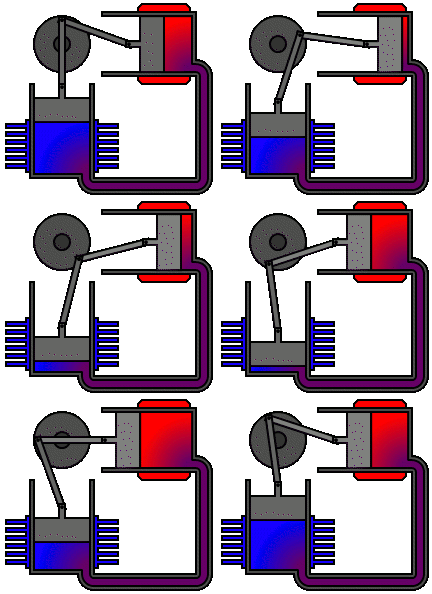
| Principle of the Stirling motor | A Stirling engine is a closed-cycle, regenerative heat engine which uses an external combustion process, heat exchangers, pistons, a 'regenerator' and a gaseous working fluid contained within the engine to convert heat to mechanical work (motion). An important feature of the Stirling is the regenerator to store energy from the gas as it passes through on the way to the cooler (low temp. heat exchanger) and gives energy to the gas as the gas flows back through the regenerator going to the heater (high temp. heat exchanger). It is the regenerator that makes the Stirling Engine. There are two main categories of Stirling engines, the kinematic which has the pistons attached to a drive mechanism which determines the phase angles and converts the linear motion of the pistons to a rotary motion and the free piston which uses harmonic motion mechanics and usually planar springs to determine the cycle phases. There are hundreds of variations of types in these two categories. Particularly the kinematic is divided into Alpha (two pistons), Beta (piston and displacer in one cylinder) and Gamma (piston and displacer in separate cylinders). Then there are the double acting engines which are alpha engines in series. These can drive either a crankshaft drive or a swashplate drive ot a cousin, the wobble drive.(...) http://www.sesusa.org/types.htm
| 
STM Power Inc. |
|
| Modern Stirling Engine | |
| >>>>More classified links<<<< | |
|
| | | |
|
 | Did you like Waoline.com for your first page ? : | |
| or to retrieve this page : |
|
 | | |
| |