"The Natural Energy Engine™, developed over the past 10 years, utilizes small amounts of heat energy from solar, geothermal, or any other heat source, including waste heat from existing processes. It can use this heat to efficiently generate electricity, desalinate or purify water, pump liquids such as water or oil, compress gas, and perform the same kinds of work done by today's other engine technologies at significantly lower cost of infrastructure and operation.
The engine is notable in that it requires no combustion, operates virtually silently, and generates no emissions. The Natural Energy Engine is also referred to as the "N E Engine", since it can perform the work of any engine.
|
Deluge Inc.
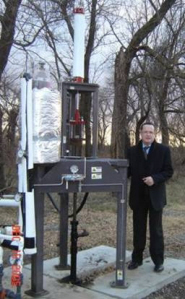
"Despite the revolutionary nature of the development, "It's really not all that complicated", says Brian Hageman, the inventor of the Natural Energy Engine. "The engine converts low-grade heat, about the temperature of hot water from your tap, into mechanical work." "It is a thermal hydraulic engine," Brian continues. "It uses the same principles of expansion and contraction from heat as an everyday thermometer, and uses the expansion to create powerful hydraulic pressure in a manner similar to an automobile's brakes."
Proof of the operating principles of the engine was achieved at the U.S. Department of Energy's Rocky Mountain Oil Testing Center in Wyoming, where a prototype engine successfully pumped crude oil from underground formations using geothermal energy as the sole source of heat for fuel. As a result, Deluge earned the coveted U.S. Department of Energy Federal Laboratories Consortium's 2005 Outstanding Technology Development Award for its Natural Energy Engine. The Federal announcement, titled "Award-Winning Engine Powered Solely by Water", stated, "Field testing proves Thermal Hydraulic Engine pumps oil without the need for fuel or electricity. This far reaching, innovative technology can literally replace any engine."
In early 2006, Deluge embarked upon extensive field testing, conducting a multi-engine long term test under varying conditions in Kansas fields, and completed well over 100,000 hours of continuous operation over more than a year. The results exceeded even Deluge's expectations in terms of reliability, costs, and performance. Publicity around its revolutionary technology has been limited to local and industry-specific sources. With commercialization to begin in 2007, Deluge has now decided to make this public announcement.
Deluge has already been approached by a number of companies large and small, including Fortune 500 companies, to begin use of the engine in various industrial applications. These include:
- Generation of substantial additional electricity simply from the waste heat in traditional power plants (major utilities).
- Operation of oil and gas wells in remote locations, utilizing solar arrays or stranded gas for heat to power the engine (major oil businesses).
- Producing drinking and irrigation water by using sunlight to power the engine to perform traditional reverse-osmosis desalination at dramatically lower cost (international sources).
- Since the Natural Energy Engine employs proven principles, commonly available materials, and available technologies, its cost is easily competitive with other engine and power-producing technologies. Engine reliability means that operating costs are extremely low, and depending on the application, fuel costs can range from low to zero." ... more
|


